
Board Certified Allergist and Immunologist
Blog
Treatments
Treatments
Personalized Care Solutions: Crafting Your Unique Wellness Journey
Discover personalized care solutions! Empower your unique wellness journey with data, technology & patient-centered plans for better health outcomes.
January 27, 2026
11 Minutes

Why Traditional Healthcare Falls Short—And What You Can Do About It
Personalized care solutions are changing how patients and doctors work together. Instead of receiving the same standard treatment as everyone else, you get care custom to your unique health history, lifestyle, genetics, and personal goals. This approach puts you at the center of your healthcare decisions and creates a plan that actually works for your life.
Here's what makes personalized care different:
- You're in control – You help create your care plan based on what matters most to you
- It's comprehensive – Your doctor looks at your whole life, not just your symptoms
- It adapts – Your plan changes as your needs change and provides realistic options
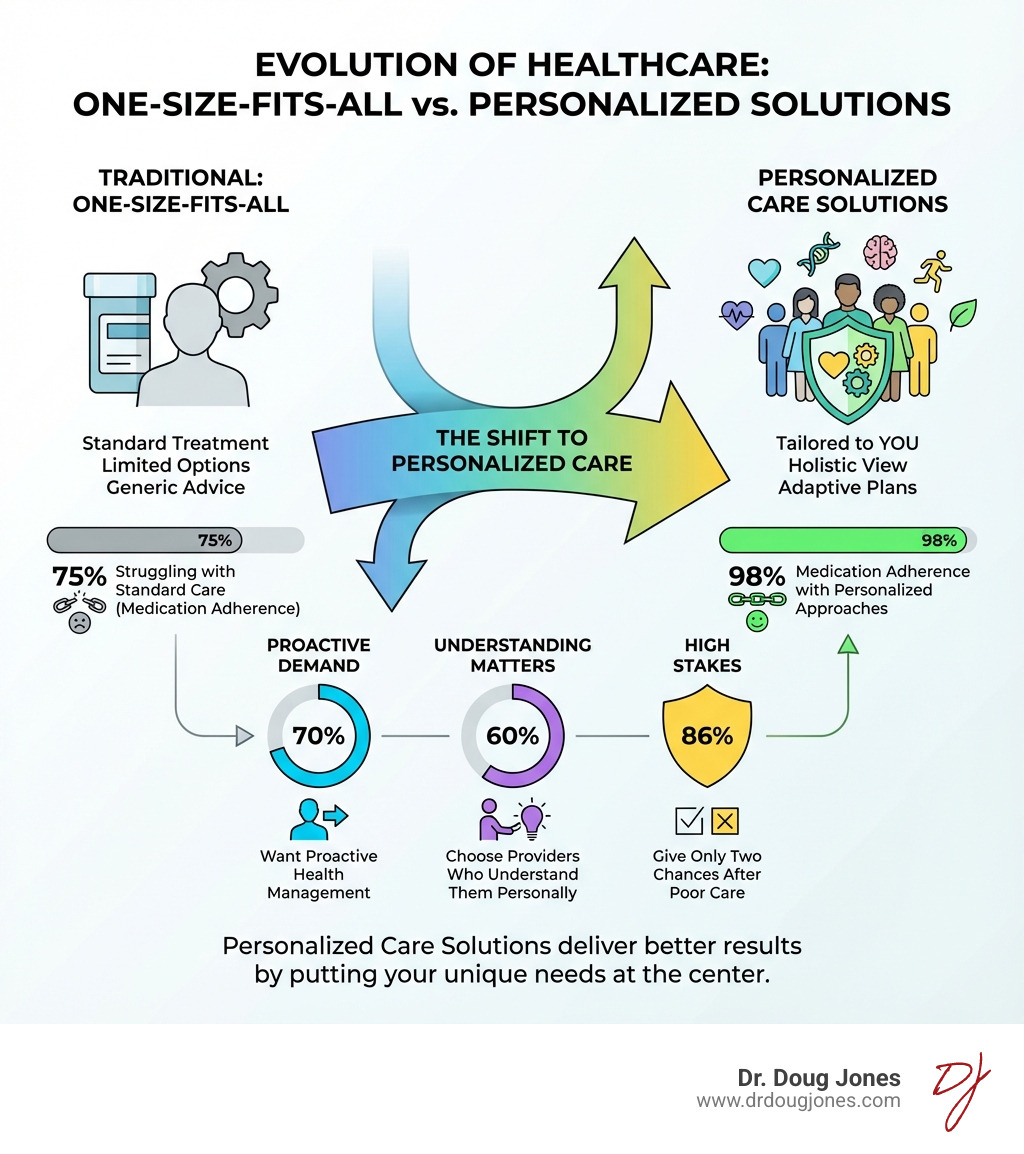
- It works better – Research shows 98% medication adherence with personalized approaches, compared to the 75% of people who struggle with standard care
- You're heard – Your preferences, concerns, and goals shape every decision
The numbers tell a compelling story. 70% of people want healthcare systems to take a more proactive role in helping them manage their health. And 60% would choose a provider based on how well they understand them beyond basic patient data. Yet most healthcare still follows a one-size-fits-all model that leaves patients frustrated and underserved.
This shift matters because the stakes are high. 86% of patients report they would only give a provider up to two chances after a poor interaction. People aren't willing to settle anymore—they want care that respects their time, understands their unique challenges, and delivers real results.
For those dealing with persistent immune challenges, chronic food allergies, or conditions like long COVID, this personalized approach isn't just nice to have—it's essential. These complex conditions don't respond well to standard protocols. They require a doctor who takes the time to understand your specific situation and creates a plan designed just for you.
I'm Dr. Doug Jones, a board-certified immunologist who has spent over a decade developing personalized care solutions for patients with complex immune conditions, food allergies, and persistent health challenges that traditional medicine often struggles to address. Through my practice at GAIN—Global Allergy Immune Network—I've seen how personalized care solutions transform outcomes for patients who were told they'd have to "just live with it."
Personalized care solutions terms at a glance:
What is Personalized Care? A Shift from "What's the Matter?" to "What Matters to You?"
Imagine a world where your healthcare plan is as unique as your fingerprint. That's the essence of personalized care. It's an approach that moves beyond simply asking "What's the matter?" to genuinely understanding "What matters to you?" This means your individual needs, preferences, health conditions, and life circumstances form the foundation of every service provided.
Personalized care is, first and foremost, a mindset. It's about recognizing that each person is a unique individual with their own story, values, and goals. We believe your care should reflect that. It’s a patient-centered approach that tailors communication, diagnostics, and care delivery to your specific characteristics. This includes everything from your demographics and medical history to your genetic makeup, social determinants of health, behavior, personal preferences, and lifestyle.
This holistic view means we look at you as a whole person, not just a collection of symptoms or diagnoses. We integrate insights from various aspects of your life to create a comprehensive picture of your well-being. This might involve considering not only your physical health but also your emotional, social, and spiritual well-being, as well as your cultural background and daily routines. This approach allows us to move beyond simply treating symptoms to address underlying factors and truly empower you. It is about creating realistic habits that serve you and that you can do. Many times patients are inundated with unrealistic recommendations that overwhelm them. This approach give realistic solutions promoting real progress and real change. I have coined the term, "Realsilience" for this approach. We can create small habits that build on each other in an integrated way.
The NHS, for example, defines personalized care as giving people choice and control over how their care is planned and delivered, based on "what matters" to them and their individual strengths and needs. It's a fundamental shift in how healthcare is delivered, aiming for better outcomes and experiences by putting you in the driver's seat. You can explore this further in the NHS's explanation of personalized care.
Let's look at how personalized care stands apart from traditional models:
| Feature | Traditional Care | Personalized Care |
|---|---|---|
| Decision-Making | Provider-led, standardized protocols | Shared decision-making, patient has choice and control |
| Care Plans | One-size-fits-all, condition-focused | Customized to individual needs, preferences, and life circumstances |
| Patient Role | Passive recipient of care | Active participant, co-creator of their health journey |
| Goals | Manage disease, alleviate symptoms | Optimize overall well-being, achieve personal life goals, address "what matters to you" |
| Focus | Medical diagnosis and treatment | Holistic well-being, integrating physical, emotional, social, and lifestyle factors |
| Relationship | Task-oriented, professional distance | Collaborative, built on trust, understanding, and empathy |
| Flexibility | Fixed schedules, limited adaptation | Adaptable, flexible scheduling, responsive to changing needs |

The Patient-Provider Partnership
At the heart of personalized care is a strong, collaborative patient-provider partnership. This isn't just a nice idea; it's a proven path to better outcomes. When we truly listen and understand your story, we can build a foundation of trust that transforms your healthcare experience.
We want you to be an active participant in your health journey. This means co-creating health plans that resonate with your values and daily life. It’s about valuing your experience, insights, and preferences. For example, if you've ever felt unheard by a doctor, you know how frustrating and disempowering that can be. Personalized care aims to change that by fostering improved communication where your voice is paramount. If you've struggled with feeling heard, these 8 Tips for When You Don't Feel Heard by Your Doctor might offer some valuable insights.
A New Model for Healthcare
Personalized care represents a systemic change, a fundamental shift in the relationship between individuals, healthcare professionals, and the entire health and care system. It's about moving from a reactive model—where we only act once you're sick—to a proactive one, where we actively support your health and well-being. This is why 70% of people want healthcare systems to take a more proactive role in helping them manage their health.
This new model emphasizes integrating health, social care, public health, and wider community services. It's an all-age approach that encompasses both mental and physical health, recognizing the vital role of carers and communities. We understand that your health is influenced by more than just medical factors; it's also shaped by your environment, social connections, and daily routines. This is where community support, like social prescribing, can connect over 900,000 people to wider community services that can help improve health and well-being. To get a clearer picture of this shift, you can watch a short animation explaining personalized care.
The Core Components of Personalized Care Solutions
To truly deliver personalized care solutions, we rely on robust frameworks and evidence-based components. The NHS, for instance, has developed a comprehensive model consisting of six key components that form a whole-system approach, integrating services around the individual. This ensures that care is not only custom but also coordinated and effective. You can find more detailed information in their Personalised care and support planning guide.

[LIST] of the 6 Key Components
- Shared Decision Making: This is about you and your healthcare professional working together to make informed decisions about your care. We discuss your options, their potential benefits and risks, and what matters most to you, ensuring your values and preferences guide the choices.
- Personalised Care and Support Planning (PCSP): This component focuses on creating a dynamic, living document that outlines "what matters to you." It details your health and well-being outcomes, and how you, with the support of professionals, will achieve them. This plan is uniquely yours, reflecting your life situation, not just your condition.
- Enabling Patient Choice: Giving you choice and control over your care isn't just about feeling empowered; it's about making care more effective. This involves providing clear, timely information about available options and supporting you to make choices that align with your personal goals and preferences.
- Social Prescribing and Community-Based Support: Sometimes, the best medicine isn't a pill. Social prescribing connects you to non-clinical services within your community that can improve your health and well-being. This might include anything from exercise groups and art classes to volunteering and debt advice. By the end of 2020/21, there were over 1,000 social prescribing link workers, and the goal is to further increase this number, connecting over 900,000 people to vital community services.
- Supported Self-Management: We empower you with the knowledge, skills, and confidence to manage your own health and well-being. This can involve health coaching, self-management programs, and peer support. Tools like the Patient Activation Measure (PAM) help assess your knowledge and confidence, allowing us to tailor support effectively.
- Personal Health Budgets: For some, having direct control over the funds allocated for their care allows for truly custom and flexible support. Personal health budgets enable individuals to commission services that precisely meet their unique needs. The NHS aims for up to 200,000 people to benefit from a personal health budget by 2023/24.
Crafting Your Personal Care and Support Plan
At Dr. Doug Jones's practice, we embody these principles, particularly in crafting your Personal Care and Support Plan. It is called ImmunoFitness STEPS or ImFitSTEPS. Each participant gets a free ImFitSTEPS journal to track your progress. For complex conditions like food allergies or Long Covid, we know that a generic approach simply won't work. We start by identifying your personal goals, focusing on "what matters to you." This means understanding your individual needs, preferences, and how your condition impacts your daily life.
Your plan is a sharable, dynamic document that records your desired outcomes and the steps to achieve them. It's written from your perspective, reflecting your unique life story. For instance, in Personalized Allergy Care, we outline a bespoke strategy that constantly adapts. Regular reviews and adjustments are built into the process, ensuring that as your life or health situation changes, your care plan evolves with you. This continuous feedback loop ensures that your plan remains relevant, effective, and truly personalized.
The Transformative Benefits for Patients and Providers
The shift to personalized care solutions isn't just about feeling better; it's about achieving measurable, transformative benefits for everyone involved. From improved patient satisfaction and health outcomes to significant financial gains for healthcare systems, personalization is proving to be a game-changer. As a BCG article titled Delivering on the Promise of Personalization in Health Care highlights, the time for this change is now.
For Patients: Better Health and Engagement
When care is custom to you, the results speak for themselves:
- Improved Treatment Adherence: This is a big one. We know that 75% of people struggle to follow their medication schedule. However, with personalized approaches and connected solutions, we've seen medication adherence rates soar to 98% for patients at home. The Personalized Medicine Coalition found that individuals with a genetic diagnosis maintained an impressive adherence rate of over 86% after two years, compared to just 38% before receiving genetic test results. When you understand why a treatment is right for you, you're much more likely to stick with it.
- Reduced Hospital Stays and Readmissions: Healthcare providers who implement personalized care strategies can see a significant reduction in the length of hospital stays and 30-day readmission rates in just 6 to 12 months. This means less time in the hospital and more time living your life.
- Effective Chronic Disease Management: For conditions like diabetes or cardiovascular disease, personalization is key to effective management. It involves custom patient education, lifestyle management, and regular monitoring, all designed around your specific needs.
- Increased Independence and Confidence: When you're empowered with a plan that truly supports you, your sense of autonomy and self-worth grows. Personalized care focuses on preserving and enhancing your abilities, helping you steer your health journey with greater confidence.
- Feeling Seen and Heard: Patients crave understanding. A survey revealed that 60% of people would choose a provider based on how well they understand them beyond basic patient data. This desire for genuine connection is paramount, especially since 86% of patients reported they would only give a provider up to two chances after a poor interaction. When you feel seen, heard, and understood, your experience is transformed.
For Providers and Systems: Improved Efficiency
The benefits extend far beyond the patient, creating a more sustainable and effective healthcare system:
- Reduced Administrative Costs: Payers that have implemented personalization have seen administrative costs drop by 5% to 10% in just 6 to 12 months. By streamlining workflows and focusing resources where they're most needed, personalized care makes the system leaner and more efficient.
- Increased Quality Standards: These same payers also reported an increase in quality standards by 20% to 25%. When care is custom, it's often of a higher quality, leading to better outcomes and fewer complications.
- Improved Financial Performance: Hospitals that offer superior patient experiences see up to 50% higher financial performance compared to average providers. Furthermore, some health systems have reported reducing expenses by up to 23% through personalized care strategies, proving that doing what's right for the patient can also be good for the bottom line.
- Better Resource Allocation: With clearer insights into patient needs and outcomes, resources can be allocated more effectively, reducing waste and optimizing care delivery.
- Reduced Clinician Burnout: By streamlining administrative burdens and empowering patients to take a more active role in their care, personalized care can free up healthcare professionals to focus on what they do best: providing care. This can lead to greater job satisfaction and reduced burnout.
The Engine of Personalization: How Data and Technology Create Better Health
The vision of personalized care is powerful, but its widespread implementation wouldn't be possible without the incredible advancements in data and technology. These tools act as the engine, allowing us to move from theoretical personalization to tangible, effective personalized care solutions at scale. Technology is crucial for delivering custom care, especially given the limitations of human time and resources.
At its core, this involves sophisticated data integration, changing raw information into actionable insights, and leveraging these insights for hyper-personalization—adapting healthcare technology to your individual lifestyle. As Salesforce highlights, Personalized Healthcare: What It Is and Why It Matters is increasingly dependent on these technological capabilities.
The Role of Data and Analytics in Personalized Care Solutions
Data is the lifeblood of personalization. Without it, we're just guessing. Here's how data and analytics play a pivotal role:
- Unified Patient Records: By centralizing patient data from various sources—like electronic health records (EHRs), wearables, and lab results—we create unified records that offer a holistic view of your health. This allows providers to make informed decisions based on a complete medical history.
- Electronic Health Records (EHRs): These are the backbone, containing crucial clinical data and details on your preferences. They serve as a central hub for your health information.
- Wearable Data: Devices like smartwatches and fitness trackers provide invaluable behavioral data, measuring physical activity, sleep patterns, and other lifestyle factors that impact your health.
- Predictive Analytics: Through advanced analytics and machine learning, we can analyze vast amounts of patient data to identify patterns, predict disease progression, and forecast patient outcomes. This supports clinicians in making precise diagnoses and optimizing treatment plans, often leading to early interventions.
- Identifying Patterns: Machine learning algorithms help us sift through complex data sets to spot trends and correlations that might otherwise be missed, leading to more targeted interventions.
- Social Determinants of Health (SDoH): Publicly available data on factors like housing, food access, and education can be integrated to provide a richer, more complete picture of your health context, allowing for even more custom support.
Key Technologies Enabling Personalized Care
The tools we use are becoming increasingly sophisticated, enabling levels of personalization previously unimaginable:
- Artificial Intelligence (AI) & Machine Learning: These technologies are at the forefront, analyzing patient data (demographics, genetics, history) to generate customized care plans, optimize drug selection and dosage, and even recommend treatment adjustments. They can also assist clinicians in analyzing medical images, lab results, and symptoms for faster, more accurate diagnoses.
- Journaling to build transformative yet realistic habits: Each participant will receive their own personalized journal, ImFitSTEPS, to set their intentions for transformation and join with a community of support to build their realistic habits to transform their lives.
- Remote Patient Monitoring: Connected solutions allow us to monitor your health in real-time from the comfort of your home. For example, 7.6 million medication doses are remotely monitored in real-time for patients at home in 2024. In a fascinating partnership, Amazon delivers pill-sized cameras to patients' doorsteps, using AI to personalize diagnoses in remote endoscopy procedures. This innovative approach is highlighted by Medtronic's AI-powered remote endoscopy procedures.
- Telehealth Platforms: These platforms facilitate remote consultations, making healthcare more accessible and convenient, especially for those in rural areas or with mobility challenges.
- Patient Portals and Apps: These digital tools empower you to access your medical records, schedule appointments, communicate directly with your care team, and receive custom educational content. While we don't offer AI-driven blood testing memberships, the concept of leveraging technology for personalized insights is powerful, as discussed in AI-Driven Functional Blood Testing Memberships: Read Before You Buy.
The Road Ahead: Challenges and the Future of Personalized Healthcare
The journey towards fully integrated and universally accessible personalized care solutions is exciting, but it's not without its bumps in the road. As we look to the future, we must acknowledge and actively work to overcome existing barriers while embracing the incredible potential that lies ahead.
Challenges to Widespread Implementation
Implementing personalized care at scale requires significant effort and collaboration:
- Data Privacy and Security (HIPAA): With the centralization and sharing of sensitive patient data, ensuring robust privacy and security measures is paramount. Compliance with regulations like HIPAA is essential for building and maintaining trust.
- High Implementation Costs: The initial investment in new technologies, infrastructure, and training can be substantial. This can be a barrier for smaller organizations or those with limited resources.
- Integrating Disparate Systems: Healthcare systems often rely on a patchwork of legacy technologies. Integrating these disparate systems to create a unified data view is a complex and time-consuming undertaking.
- Workforce Training and Cultural Shift: Personalized care requires a different mindset and new skills for healthcare professionals. Continuous training and a cultural shift towards patient empowerment are necessary. The Personalised Care Institute, for example, aims to train 75,000 health and care professionals via its eLearning platform and accredited training partners.
- Ensuring Equitable Access: We must ensure that the benefits of personalized care are available to everyone, not just a privileged few. Addressing health inequalities and serving populations poorly served by conventional services is a critical ethical consideration.
The Future of Personalized Care Solutions
Despite these challenges, the future of personalized care is incredibly promising and will continue to evolve rapidly:
- Greater Use of AI and Predictive Models: We can expect even more sophisticated AI and machine learning applications to analyze complex genetic, environmental, and lifestyle data. This will lead to highly accurate predictive models for disease risk, personalized prevention strategies, and even more precise treatment recommendations.
- Increased Patient Control over Data: As technology advances, patients will likely gain even greater control over their health data, deciding who can access it and how it's used. This empowerment aligns perfectly with the core philosophy of personalized care.
- Seamless Integration of Digital and In-Person Care: The lines between virtual and physical care will blur further, creating hybrid models that offer the best of both worlds—convenient digital tools combined with essential in-person interactions.
- Focus on Prevention and Wellness: Personalized care will continue to emphasize proactive health management, using data to identify risks early and implement custom wellness programs, helping you stay healthy rather than just treating illness.
- The NHS Long Term Plan Goal of Reaching Millions: Ambitious initiatives, like the NHS Long Term Plan, aim to roll out personalized care to 2.5 million people by 2023/24, with the goal of doubling that reach within a decade. This demonstrates a clear commitment to making personalized care a standard, rather than an exception.
Conclusion: Taking Control of Your Health Journey
We've explored how personalized care solutions represent a profound shift in healthcare, moving from a one-size-fits-all model to one that puts you, the individual, at the very center. It’s about understanding "what matters to you" and crafting a health journey that genuinely reflects your unique needs, preferences, and goals. The benefits are clear: improved health outcomes, greater patient engagement, and a more efficient, effective healthcare system for all.
The power of being an active participant in your care cannot be overstated. When you're involved in every decision, when your voice is heard, and when your plan is custom precisely for you, you gain a sense of control and empowerment that is truly transformative. We believe this isn't just a luxury; it's a fundamental right. As the saying goes, every individual deserves care that honors their unique story, preferences, and goals.
The future is now, with technology serving as an incredible enabler, changing complex data into actionable insights and supporting hyper-personalized approaches. At Dr. Doug Jones's practice, we embody this philosophy, particularly for those struggling with complex immune challenges, persistent food allergies, or long COVID. We know that finding the right answers can be a long and frustrating journey, often requiring you to go From Specialist to Specialist: Why You Still Don't Have Answers & What to Do Next.
Our philosophy is simple: empower individuals with lasting relief through personalized care and education. We don't just treat conditions; we partner with you to understand the intricate details of your immune health and craft personalized care solutions that deliver real, sustainable results.
If you're ready to experience healthcare that truly understands you, we invite you to begin your journey with personalized allergy care today.